China at a Glance: Fast Facts, Geography, People & Travel Essentials
Everything you need to know before traveling to China — size, population, ethnic groups, language, time zones, currency, and more. Your complete China overview for 2026.
China at a Glance
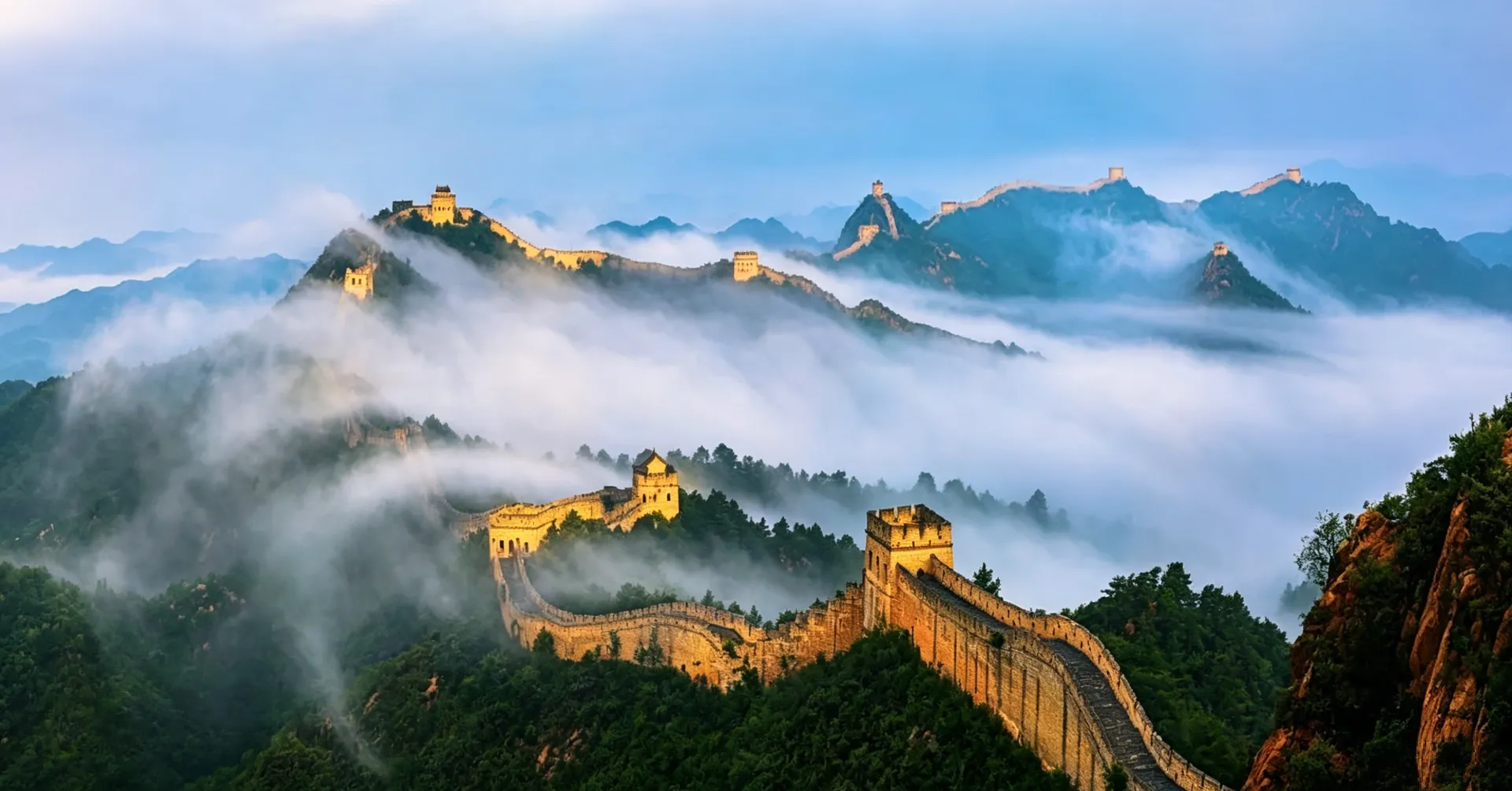
Welcome to China — a land where 5,000 years of continuous civilization meets futuristic cities, where steaming dumplings share the table with Michelin-starred innovation, and where you can ride the world's fastest train in the morning and walk the Great Wall in the afternoon.
Whether you're dreaming of your first trip or already packing your bags, this overview will ground you in the essentials: how big China really is, who lives here, what languages you'll hear, how to pay for things, and when to visit. Think of this as your pre-trip briefing — the stuff every traveler wishes they'd known before landing.
Fast Facts at a Glance
Before diving into the details, here's everything at a glance:
| Category | Detail |
|---|---|
| Official Name | People's Republic of China (中华人民共和国) |
| Capital | Beijing (北京) |
| Total Area | 9,596,961 km² (3,705,407 sq mi) |
| Population | ~1.42 billion (2026 est.) |
| Official Language | Mandarin Chinese (Putonghua / 普通话) |
| Currency | Renminbi (RMB / CNY / ¥) |
| Time Zone | China Standard Time (UTC+8) — single time zone nationwide |
| International Dialing Code | +86 |
| Standard Voltage | 220V / 50Hz (Type A, C, and I plugs) |
| Driving Side | Right |
| Largest Cities | Shanghai, Beijing, Guangzhou, Shenzhen, Chengdu, Chongqing |
| GDP | ~$18 trillion USD (2026 est., second-largest in the world) |
| Internet TLD | .cn |
Geography & Size
Just How Big Is China?
Let's put it in perspective. China is:
- Roughly the same size as the entire European continent — yes, the whole thing
- Slightly larger than the United States (including Alaska and Hawaii)
- About 40 times the size of the United Kingdom
- Spans approximately 5,200 km east to west and 5,500 km north to south
If you flew from Mohe in the frozen northeast to the tropical beaches of Hainan Island, you'd cover roughly the same distance as flying from London to Baghdad. If you drove from Shanghai on the Pacific coast to Kashgar near the Central Asian border, you'd travel farther than driving from New York to Los Angeles.
The Three-Step Topography
China's landscape rises like a colossal staircase from east to west — geographers call this the "Three-Step Staircase":
Step 1: The Eastern Plains (0–500m) The densely populated coastal lowlands where most major cities sit — Beijing, Shanghai, Guangzhou. Fertile farmland, river deltas, and urban sprawl. This is where 90% of China's population lives.
Step 2: The Central Plateaus & Basins (1,000–2,000m) Rising westward, you encounter the Loess Plateau (the Yellow River's cradle), the Sichuan Basin (panda country and spicy food heartland), and the Inner Mongolian grasslands. Think wide-open spaces, dramatic gorges, and dramatically different cuisines.
Step 3: The High Plateau (4,000m+) The Tibetan Plateau — the "Roof of the World" — averages over 4,000 meters above sea level. This is where the Yangtze and Yellow Rivers begin their journeys eastward. The Himalayas crown the southern edge, with Mount Everest straddling the Nepal–China border.

Major Rivers & Mountains
| Feature | Name | Significance |
|---|---|---|
| Longest River | Yangtze (长江, 6,300 km) | Third-longest in the world; the Three Gorges Dam; cruise from Chongqing to Yichang |
| Cradle of Civilization | Yellow River (黄河, 5,464 km) | Birthplace of Chinese civilization; Loess Plateau landscapes |
| Southern Artery | Pearl River (珠江, 2,400 km) | Flows through Guangzhou and the Pearl River Delta megacity region |
| Highest Peak | Mount Everest / Qomolangma (8,848m) | On the Tibet–Nepal border; base camp accessible from the Tibetan side |
| Iconic Mountain Range | Huangshan / Yellow Mountains | Granite peaks, ancient pines, and sea-of-clouds views — a UNESCO site since 1990 |
Administrative Divisions
China has a structured administrative system. At a glance:
- 23 Provinces — The basic administrative units (e.g., Guangdong, Sichuan, Yunnan)
- 5 Autonomous Regions — Regions with large ethnic minority populations (Guangxi, Inner Mongolia, Ningxia, Tibet, Xinjiang)
- 4 Municipalities — Mega-cities administered directly by the central government (Beijing, Shanghai, Tianjin, Chongqing)
- 2 Special Administrative Regions (SARs) — Hong Kong and Macau, with their own legal and economic systems
Complete List of Province-Level Divisions
| English Name | Chinese Name | Type | Capital / Seat |
|---|---|---|---|
| Anhui | 安徽 | Province | Hefei |
| Beijing | 北京 | Municipality | — |
| Chongqing | 重庆 | Municipality | — |
| Fujian | 福建 | Province | Fuzhou |
| Gansu | 甘肃 | Province | Lanzhou |
| Guangdong | 广东 | Province | Guangzhou |
| Guangxi | 广西 | Autonomous Region | Nanning |
| Guizhou | 贵州 | Province | Guiyang |
| Hainan | 海南 | Province | Haikou |
| Hebei | 河北 | Province | Shijiazhuang |
| Heilongjiang | 黑龙江 | Province | Harbin |
| Henan | 河南 | Province | Zhengzhou |
| Hubei | 湖北 | Province | Wuhan |
| Hunan | 湖南 | Province | Changsha |
| Hong Kong | 香港 | SAR | — |
| Inner Mongolia | 内蒙古 | Autonomous Region | Hohhot |
| Jiangsu | 江苏 | Province | Nanjing |
| Jiangxi | 江西 | Province | Nanchang |
| Jilin | 吉林 | Province | Changchun |
| Liaoning | 辽宁 | Province | Shenyang |
| Macau | 澳门 | SAR | — |
| Ningxia | 宁夏 | Autonomous Region | Yinchuan |
| Qinghai | 青海 | Province | Xining |
| Shaanxi | 陕西 | Province | Xi'an |
| Shandong | 山东 | Province | Jinan |
| Shanghai | 上海 | Municipality | — |
| Shanxi | 山西 | Province | Taiyuan |
| Sichuan | 四川 | Province | Chengdu |
| Tianjin | 天津 | Municipality | — |
| Tibet | 西藏 | Autonomous Region | Lhasa |
| Xinjiang | 新疆 | Autonomous Region | Ürümqi |
| Yunnan | 云南 | Province | Kunming |
| Zhejiang | 浙江 | Province | Hangzhou |
For travelers, the key takeaway: don't confuse provinces with cities. "Sichuan" is a province roughly the size of France; Chengdu is its capital city. Booking a flight to "Yunnan" won't get you far — you're looking for Kunming, Dali, or Lijiang.
Population & Ethnic Groups
The Numbers
China is home to approximately 1.42 billion people — roughly 18% of humanity. To put that in context: more people live in China than in all of Europe, North America, and South America combined.
The population is heavily concentrated in the eastern third of the country. The imaginary "Heihe–Tengchong Line" drawn across China shows this starkly: roughly 94% of the population lives east of this line, on only 43% of the land.
Ethnic Diversity
China officially recognizes 56 ethnic groups. The Han Chinese make up approximately 91.5% of the population (about 1.3 billion people). The remaining 8.5% — over 110 million people — belong to 55 officially recognized ethnic minorities.
| Ethnic Group | Population (~) | Primary Regions | Cultural Highlights |
|---|---|---|---|
| Zhuang (壮族) | 17 million | Guangxi | Colorful embroidered costumes, the San Yue San (March 3rd) song festival, unique rice-based cuisine |
| Hui (回族) | 10.5 million | Ningxia, Gansu, nationwide | Chinese-speaking Muslims, distinctive halal cuisine (pulled noodles, lamb dishes), ornate mosques blending Chinese and Islamic architecture |
| Manchu (满族) | 10 million | Northeast China (Manchuria) | Former rulers of the Qing Dynasty; traditions preserved in clothing, cuisine (hot pot origins), and festivals |
| Uyghur (维吾尔族) | 10 million | Xinjiang | Turkic language and culture, Central Asian-influenced cuisine (polo/pilaf, naan, lamb skewers), vibrant bazaars, the ancient Silk Road city of Kashgar |
| Miao (苗族) | 9.4 million | Guizhou, Hunan, Yunnan | Intricate silver jewelry, elaborate embroidery, terraced rice fields, the Miao New Year celebration |
| Tibetan (藏族) | 6.3 million | Tibet, Qinghai, Sichuan, Yunnan | Tibetan Buddhism, soaring monasteries (Potala Palace, Jokhang Temple), high-altitude nomadic traditions, thangka art |
| Mongol (蒙古族) | 5.8 million | Inner Mongolia | Nomadic heritage, the Naadam Festival (wrestling, horse racing, archery), grassland yurt stays, throat singing |
| Yi (彝族) | 8.7 million | Sichuan, Yunnan, Guizhou | The Torch Festival, distinctive silver headdresses, the ancient Yi script (one of the few indigenous writing systems still in use) |

Language & Writing
Mandarin: The Common Tongue
Standard Mandarin (Putonghua / 普通话, literally "common speech") is China's official language, taught in every school and spoken by virtually everyone under 50. It's one of the six official languages of the United Nations.
Mandarin is a tonal language with four tones plus a neutral tone — meaning the same syllable can mean completely different things depending on pitch. The classic example: "ma" can mean "mother" (mā), "hemp" (má), "horse" (mǎ), or "to scold" (mà), depending on how your voice rises and falls.
The Writing System
Chinese uses characters (汉字 / hànzì) — logograms that represent meaning rather than sound. There are over 50,000 characters, but functional literacy requires knowing about 2,000–3,000. Each character is composed of strokes and radicals, making the writing system both art and communication.
Modern Chinese uses simplified characters (简体字) on the mainland and traditional characters (繁體字) in Hong Kong, Macau, and Taiwan. As a traveler, you'll encounter simplified characters on all mainland signage.
Regional Dialects
While Mandarin unifies the country, regional languages and dialects thrive:
| Language / Dialect | Where You'll Hear It | Notes for Travelers |
|---|---|---|
| Cantonese (粤语) | Guangdong, Guangxi, Hong Kong, Macau | Widely spoken in overseas Chinese communities; very different from Mandarin |
| Shanghainese (上海话) | Shanghai and surrounding Jiangsu/Zhejiang | A Wu dialect; largely unintelligible to Mandarin speakers |
| Hokkien / Minnan (闽南语) | Southern Fujian, Taiwan, Southeast Asia | One of the oldest Chinese language varieties |
| Sichuanese (四川话) | Sichuan and Chongqing | A Mandarin dialect with distinctive pronunciation — sounds musical and relaxed |
Practical Communication for Travelers
| Scenario | What to Expect |
|---|---|
| International Hotels | Front desk staff speak good English |
| Major Airports | English signage throughout |
| High-Speed Trains | English announcements and signage |
| Young People (under 30) | Basic English common in big cities |
| Small Restaurants & Shops | Little to no English — pointing and translation apps are your friends |
| Taxis | Have your destination written in Chinese characters |
Time Zones
Here's a fun fact that surprises almost every first-time visitor: China uses a single time zone — Beijing Time (UTC+8) — across the entire country, even though it geographically spans five time zones.
| What This Means | Example |
|---|---|
| Sun rises late in the west | In Kashgar (Xinjiang), the sun might not rise until 10:00 AM in winter, and it stays light until nearly midnight in summer |
| Everyone operates on Beijing Time | Flight schedules, train departures, business hours — all Beijing Time, even in Xinjiang or Tibet |
| Local communities adapt informally | Uyghurs in Xinjiang often run their daily lives on an unofficial "Xinjiang Time" (UTC+6), but all official clocks show Beijing Time |
| Jet lag can be confusing | If you're flying from Shanghai to Ürümqi, your watch stays the same but the sun sets 2+ hours later |
Currency & Payment
The Basics
China's official currency is the Renminbi (RMB / CNY) — literally "the people's currency." The primary unit is the yuán (元 / ¥) , divided into 10 jiǎo (角) or 100 fēn (分). In everyday speech, people say "kuài" instead of "yuán" — similar to how Americans say "bucks" instead of "dollars."
| Denomination | Notes & Coins |
|---|---|
| ¥100, ¥50, ¥20, ¥10, ¥5, ¥1 | Paper notes (¥100 is the most commonly used) |
| ¥1, ¥0.5 (5 jiǎo) | Coins |
The Cashless Revolution
China is arguably the world's most cashless society. From street food stalls to luxury boutiques, nearly every transaction happens via QR code. The two dominant platforms:
- WeChat Pay (微信支付) — Built into WeChat, the messaging app used by virtually everyone
- Alipay (支付宝) — The financial platform from Alibaba, equally ubiquitous
For foreign travelers, the good news is that both platforms now support international credit cards:
- Download Alipay or WeChat before your trip
- Register and verify your identity (passport required)
- Add your international Visa/Mastercard
- Scan QR codes to pay — it's that simple
Cash & Cards
| Payment Method | Where It Works | Foreigner-Friendliness |
|---|---|---|
| WeChat Pay / Alipay | Virtually everywhere | ★★★★★ (once set up, it's magic) |
| Cash (RMB) | Accepted everywhere, but increasingly rare | ★★★★☆ (Carry ¥200–500 for emergencies) |
| International Credit Cards | Major hotels, high-end restaurants, airports | ★★☆☆☆ (Don't rely on them as your primary method) |
| UnionPay | Everywhere | ★★★★☆ (If your bank issues a UnionPay card) |
Climate & Best Times to Visit
China's climate is as diverse as its geography. In January, you could be skiing in Harbin (-25°C) in the morning and sunbathing in Sanya (+25°C) by evening. There is no single "best time" — it depends entirely on where you're going.
Seasonal Overview
| Season | Months | Temperature Range | Best For | Packing Advice |
|---|---|---|---|---|
| Spring 🌸 | March–May | 10°C to 25°C (varies by region) | Ideal for most destinations; cherry blossoms, mild temperatures, clear skies | Layers — mornings can be cool, afternoons warm |
| Summer ☀️ | June–August | 25°C to 38°C (hot and humid in the east/south) | Tibet, Yunnan, Inner Mongolia, Qinghai (cooler highlands); indoor city attractions | Lightweight, breathable clothing; umbrella for sudden rainstorms |
| Autumn 🍂 | September–November | 10°C to 25°C | The golden season — clear skies, crisp air, fall foliage; best for photography and outdoor sightseeing | Light jacket, comfortable walking shoes |
| Winter ❄️ | December–February | -25°C (northeast) to 20°C (south) | Harbin Ice Festival, skiing, southern China (Yunnan, Hainan, Guangxi); fewer crowds, lower prices | Heavy coat for the north; sweater for the south |
The Golden Windows
For the most comfortable all-around trip, aim for:
- April–May (Spring): Pleasant temperatures across most of China; cherry and plum blossoms; manageable crowds
- September–October (Autumn): The weather is near-perfect — golden light, clear skies, crisp air. This is arguably the best time for photography and outdoor attractions like the Great Wall
When NOT to Go
| Period | Why to Avoid |
|---|---|
| Chinese New Year (late Jan–mid Feb) | The world's largest annual human migration — trains, flights, hotels fully booked; many businesses closed for 1–2 weeks |
| National Day "Golden Week" (Oct 1–7) | Every major attraction is packed to capacity; hotel prices triple; the Great Wall becomes a "Great Crowd" |
| June–August (Eastern Cities) | Oppressively hot and humid in Beijing, Shanghai, Nanjing — "sauna weather" |
Ready to Start Planning?
You're now armed with the foundational knowledge every traveler to China needs. Mountains that scratch the sky, rivers that shaped civilizations, cities that pulse with 20 million people, and corner noodle shops that will ruin you for takeout back home — all of it is waiting.
Next Steps:
- 📋 Check if you need a visa — and which visa-free policies apply to you
- 🏙️ Explore our city guides — Beijing, Shanghai, Chengdu, Xi'an, and Guilin
- 🍜 Dive into Chinese food culture — what to eat and how to order it
- 📧 Subscribe for updates — get new guides and policy changes delivered to your inbox
Have questions about planning your China trip?
Drop a comment below — our team and community of experienced travelers are here to help. Whether it's about visas, itineraries, or which SIM card to get, ask away!
Continue Reading
China Provinces & Regions: A Traveler's Guide to China's Administrative Divisions
Understand China's 23 provinces, 5 autonomous regions, 4 municipalities, and 2 SARs. A clear guide to China's size and regional differences for travelers.
Essential China Travel Tips 2026: Internet, Payment, Transport & Safety
Everything you need to know before traveling to China — VPN setup, mobile payments, high-speed trains, safety tips, packing checklist, and more. A practical guide for first-time visitors.
Language Barrier in China – Essential Tips for English Speakers
Traveling in China without speaking Chinese? Discover the best translation apps, essential phrases, English-friendly cities ranked, and printable communication cards for a smooth trip.
Get Weekly China Travel Tips
Join our newsletter for destination guides, travel hacks, visa updates, and insider recommendations delivered to your inbox.
No spam. Unsubscribe anytime.