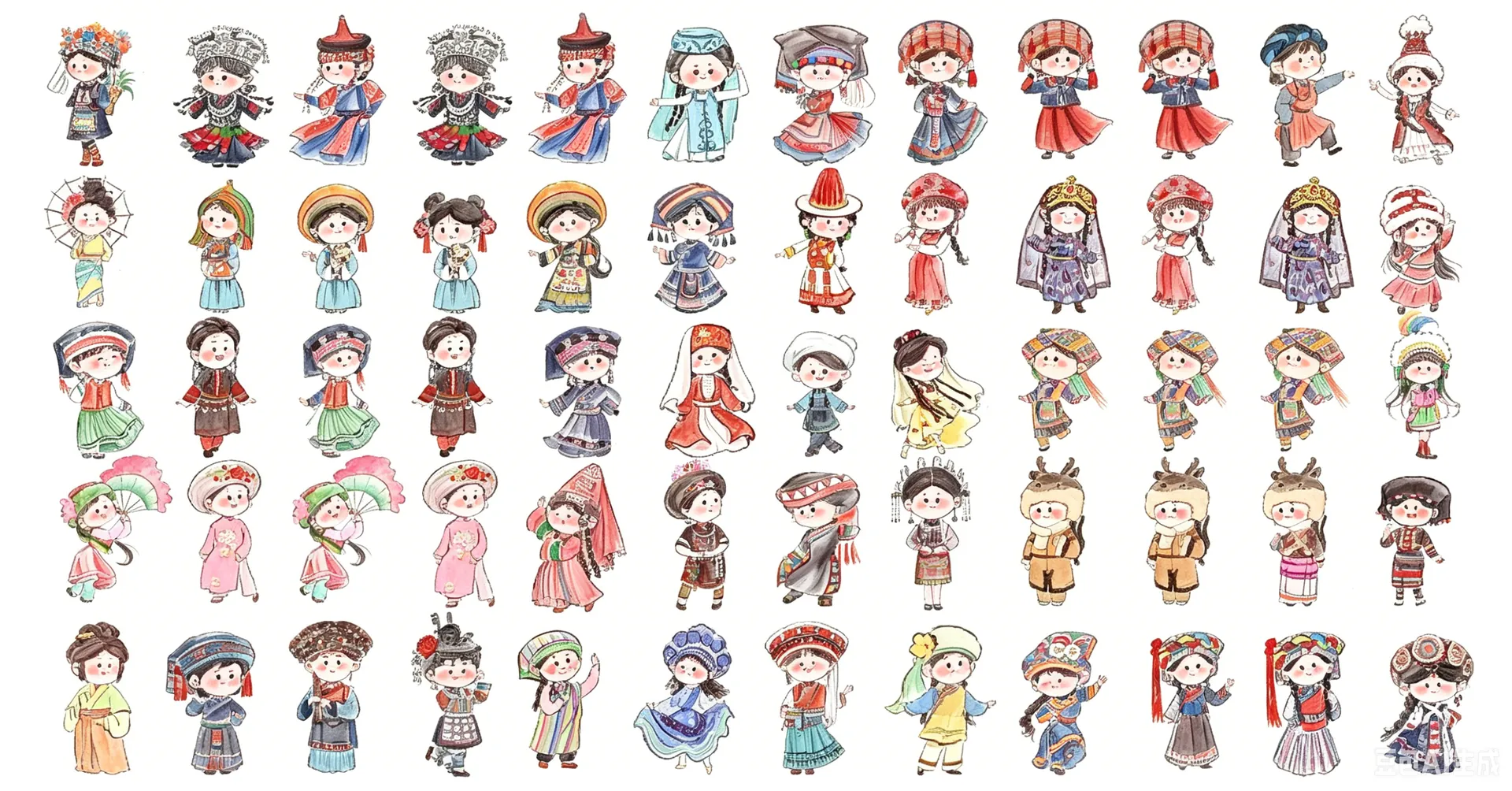
China's 56 Ethnic Groups — A Cultural Guide for Travelers
Discover the rich diversity of China's 56 ethnic groups. Learn about Zhuang, Hui, Tibetan, Uyghur, Mongolian, Miao cultures and the best regions to experience them.
China's 56 Ethnic Groups
Think of China as a cultural mosaic — 56 distinct ethnic groups, each with its own language, clothing, cuisine, festivals, and traditions, sharing one nation. While international travelers often arrive knowing only "Chinese culture," those who venture into minority regions discover an entirely different China — one of alpine monasteries, grassland nomads, tropical water festivals, and mountain villages where silver-clad grandmothers sing songs passed down through centuries.
A Tapestry of Cultures
China officially recognizes 56 ethnic groups (民族 / mínzú). Together they form one of the world's most diverse nations — a living museum of languages, religions, art forms, and ways of life that have coexisted for millennia.
| Category | Population | Share |
|---|---|---|
| Han Chinese (汉族) | ~1.3 billion | ~91.5% |
| 55 Ethnic Minorities (少数民族) | ~110 million | ~8.5% |
The 8.5% figure might sound small, but 110 million people is roughly the population of Ethiopia or the Philippines. And because minority populations are concentrated in specific regions — Tibet, Xinjiang, Yunnan, Guizhou, Guangxi, Inner Mongolia — visiting those areas feels like entering an entirely different cultural world.

The Han Majority
The Han Chinese (汉族) are the world's largest ethnic group. Their civilization dates back over 4,000 years to the Yellow River Valley, and their cultural influence extends across East Asia.
Where Han Culture Flourishes
Han communities are concentrated in China's eastern and central plains — the great river valleys of the Yellow River and Yangtze. Major Han cultural centers include Beijing, Xi'an, Nanjing, Chengdu, and Guangzhou. Each region has its own distinctive Han subculture: the refined tea ceremonies of Hangzhou differ markedly from the bold flavors of Sichuan Han cuisine.
Key Han Festivals
| Festival | When | What to Experience |
|---|---|---|
| Spring Festival (春节 / Chinese New Year) | Late Jan – mid Feb | Fireworks, red lanterns, family reunions, dumpling-making, temple fairs — the world's largest annual migration |
| Mid-Autumn Festival (中秋节) | Sept – Oct (full moon) | Mooncakes, lantern displays, family gatherings under the full moon |
| Dragon Boat Festival (端午节) | June (lunar May 5th) | Dragon boat races, zongzi (sticky rice dumplings wrapped in bamboo leaves) |
| Qingming Festival (清明节 / Tomb Sweeping Day) | April 4–5 | Ancestral tomb sweeping, spring outings, kite flying |
Meet the Major Ethnic Minorities
Here are six of the largest and most culturally distinctive ethnic minority groups — each offering a completely different lens on China.
The Zhuang (壮族) — ~17 Million
Where: Guangxi Zhuang Autonomous Region, with smaller communities in Yunnan and Guangdong.
The Zhuang are China's largest ethnic minority, yet they remain one of the least known to international travelers — partly because they've integrated deeply with Han society. Their heartland, Guangxi, is home to the iconic karst landscapes of Guilin and Yangshuo, making this one of China's most visually stunning minority regions.
Cultural highlights: The San Yue San (March 3rd Festival) is the Zhuang equivalent of Valentine's Day plus a music festival — thousands gather to sing antiphonal love songs across the hills. Zhuang brocade textiles, featuring intricate geometric patterns in indigo and crimson, are UNESCO-recognized.
What to eat: Luosifen (river snail rice noodles) — pungent, spicy, and wildly popular across China. Zhuang sticky rice dyed in five colors using natural plant pigments.

The Hui (回族) — ~10.5 Million
Where: Ningxia Hui Autonomous Region, plus significant communities in Gansu, Qinghai, Xinjiang, and most Chinese cities.
The Hui are ethnically Chinese but culturally Muslim — their ancestors include Arab and Persian traders who settled along the Silk Road over a thousand years ago. Unlike most other minorities, the Hui are scattered across China rather than concentrated in one region, which means you'll encounter Hui culture and food in nearly every city.
Cultural highlights: The Great Mosque of Xi'an — one of China's oldest and most architecturally unique mosques, built in a Chinese pavilion style rather than the domed Middle Eastern style. Ningxia's capital Yinchuan is the perfect base for Hui cultural tourism.
What to eat: Hui cuisine is arguably China's most traveler-friendly — halal beef noodles (niurou lamian, hand-pulled before your eyes), lamb skewers seasoned with cumin and chili, yangrou paomo (crumbled flatbread in lamb soup), and sweet chrysanthemum tea.

The Tibetan (藏族) — ~6.3 Million
Where: Tibet Autonomous Region, plus large Tibetan areas in Qinghai, western Sichuan (Ganzi, Aba), Yunnan (Diqing/Shangri-La), and Gansu (Gannan).
Tibetan culture is one of the world's great spiritual traditions. Tibetan Buddhism infuses every aspect of daily life — from the prayer flags fluttering on mountain passes to the prostrating pilgrims circling temples. The landscape itself feels sacred: vast grasslands at 3,500 meters, turquoise glacial lakes, and snow peaks that scrape the stratosphere.
Cultural highlights: The Potala Palace and Jokhang Temple in Lhasa are the spiritual heart of Tibetan Buddhism. The Shoton Festival (雪顿节 / Yogurt Festival) in August features giant thangka unveilings at Drepung Monastery and Tibetan opera performances. For a less restricted Tibetan experience, visit Xiahe (Labrang Monastery) in Gansu or Shangri-La in Yunnan.
What to eat: Yak butter tea (salty, rich, an acquired taste), tsampa (roasted barley flour), yak meat dumplings (momo), and Tibetan yogurt sweetened with honey.

The Uyghur (维吾尔族) — ~10 Million
Where: Xinjiang Uyghur Autonomous Region, Central Asia's great crossroads.
Xinjiang — six time zones wide, larger than France, Germany, and Spain combined — is the Uyghur homeland. This is China's most Central Asian region, where the legacy of the Silk Road is alive in every bazaar, mosque, and plate of lamb pilaf. Uyghur culture is Turkic in origin, with a language related to Turkish and Uzbek, written in an Arabic-derived script.
Cultural highlights: The Sunday Bazaar in Kashgar — one of Asia's great markets, where traders have gathered for over 2,000 years. The old city of Kashgar itself, with its maze-like clay-brick alleyways, feels more like Samarkand than Shanghai. Uyghur meshrep gatherings combine music, dance, poetry, and storytelling — if you're lucky enough to be invited, go.
What to eat: Uyghur polo (lamb pilaf with carrots and raisins), laghman (hand-pulled noodles with lamb and vegetables), freshly baked naan from tandoor ovens, lamb skewers (kawap), and melons so sweet they taste like candy.

The Mongolian (蒙古族) — ~5.8 Million
Where: Inner Mongolia Autonomous Region, plus smaller communities in Qinghai, Xinjiang, and Northeast China.
The Mongolian steppe stretches in every direction — an ocean of grass under an enormous sky. Mongolian culture is inseparable from the horse: children learn to ride before they can walk, and the legendary hospitality of nomadic families means you'll never pass a ger (yurt) without being offered milk tea.
Cultural highlights: The Naadam Festival (那达慕) in July — the "Three Games of Men" — wrestling, horse racing, and archery, though women compete in the latter two. Crowds gather in their finest silk deels (traditional robes), and the grasslands echo with the sound of the morin khuur (horse-head fiddle).
What to eat: Mongolian hot pot (the original version, with lamb boiled in a copper pot), hand-grasped lamb (shouba rou), fermented mare's milk (airag), and dairy in every conceivable form — cheese, yogurt, milk tea, milk liquor.
Where to stay: A ger camp on the Hulunbuir or Xilingol grasslands is one of China's essential travel experiences. Wake to horses nickering outside your felt-walled tent, drink milk tea with a nomadic family, and gallop across a landscape that hasn't changed in a thousand years.

The Miao (苗族) — ~9.4 Million
Where: Guizhou, Hunan, and Yunnan provinces, with the largest concentrations in Guizhou's Qiandongnan Prefecture.
The Miao are famous for their dazzling silver jewelry and intricate embroidery — a Miao woman's festival outfit can weigh over 15 kilograms (33 pounds) in silver alone. The patterns embroidered into their clothing aren't just decoration — they're a historical record, encoding migration routes, legends, and family lineages that were never written down.
Cultural highlights: The Miao New Year (苗年) in October/November is the largest Miao celebration — villages host feasts of glutinous rice wine, and everyone dances to the rhythmic beat of the lusheng (bamboo reed pipe). The Sisters' Meal Festival (姐妹节) in April is the Miao equivalent of a courtship festival, with young women in full silver regalia offering dyed sticky rice to potential suitors.
What to eat: Sour and spicy is the Miao flavor profile. Suantangyu (sour soup fish) is the signature dish — freshwater fish poached in a tangy fermented rice broth with mountain herbs and chilies.
Where to stay: Xijiang Miao Village in Guizhou is the world's largest Miao village — over 1,000 wooden stilt houses (diaojiaolou) cascade down a hillside. Stay overnight for the moment when the tour buses leave and the village transforms: thousands of lights twinkling on the mountainside, the sound of lusheng pipes drifting through the valley.

Minority Populations at a Glance
| Ethnic Group | Population (~) | Primary Region | Signature Experience |
|---|---|---|---|
| Zhuang | 17 million | Guangxi | San Yue San song festival, karst landscapes |
| Hui | 10.5 million | Ningxia, nationwide | Halal cuisine, Xi'an Great Mosque |
| Uyghur | 10 million | Xinjiang | Kashgar Sunday Bazaar, Silk Road heritage |
| Miao | 9.4 million | Guizhou, Hunan, Yunnan | Silver jewelry, Miao New Year, stilt villages |
| Yi | 8.7 million | Sichuan, Yunnan | Torch Festival, ancient Yi script |
| Tujia | 8.0 million | Hunan, Hubei, Guizhou | Waving dance, Zhangjiajie mountains |
| Tibetan | 6.3 million | Tibet, Qinghai, Sichuan | Buddhist monasteries, Shoton Festival |
| Mongolian | 5.8 million | Inner Mongolia | Naadam Festival, grassland nomad stays |
| Dong | 2.9 million | Guizhou, Guangxi | Wind-and-rain bridges, polyphonic choir singing |
Why Visit Ethnic Regions?
The most memorable travel experiences in China often happen far from the skyscrapers. Here's what you'll find in minority regions:
| Experience | Where to Go |
|---|---|
| Festivals unlike anything at home | Naadam (Inner Mongolia), Water Splashing Festival (Dai, Yunnan), Miao New Year (Guizhou) |
| Architecture that defies imagination | Tibetan monasteries clinging to cliffs, Dong wind-and-rain bridges built without a single nail, Miao stilt villages |
| Food you'll dream about | Uyghur pilaf, Tibetan momos, Miao sour soup fish, Hui hand-pulled noodles |
| Handicrafts & textiles | Miao silverwork, Tibetan thangka painting, Uyghur carpets, Zhuang brocade |
| Landscapes of staggering scale | Tibetan plateau, Mongolian grasslands, Yunnan's terraced rice paddies |
Suggested Minority-Focused Routes
Yunnan Cultural Loop (10–14 days): Kunming → Dali (Bai culture) → Lijiang (Naxi culture, Dongba script) → Shangri-La (Tibetan culture, Songzanlin Monastery) → back to Kunming
Guizhou Village Trail (7–10 days): Guiyang → Kaili → Xijiang (Miao) → Zhaoxing (Dong) → Basha (Miao, last gun-toting tribe) → Zhenyuan → Guiyang
Silk Road Odyssey (14+ days): Xi'an (Hui Muslim Quarter) → Lanzhou → Xiahe (Tibetan Labrang Monastery) → Zhangye → Dunhuang → Turpan → Ürümqi → Kashgar (Uyghur culture)
Cultural Sensitivity Tips
Traveling respectfully in minority regions not only shows good manners — it opens doors to genuine human connection.
Do:
- Learn a few words in the local language — "hello" and "thank you" in Tibetan, Uyghur, or Mongolian go a very long way
- Ask permission before photographing people — and respect a "no"
- Dress modestly when visiting temples, mosques, and monasteries — cover shoulders and knees
- Accept food and drink when offered — refusing hospitality can be interpreted as rejection
- Remove your shoes before entering temples, mosques, and private homes
- Walk clockwise around Buddhist stupas, prayer wheels, and sacred sites
Don't:
- Touch people's heads — in Tibetan and many Southeast Asian cultures, the head is considered sacred
- Point your feet at Buddha statues or religious objects — sit cross-legged or with feet tucked behind you
- Take photos during religious ceremonies without explicit permission
- Assume you can enter a mosque during prayer times — check visiting hours in advance
- Discuss politically sensitive topics — focus on culture, food, and shared human experiences
A Journey Through Living Cultures
China's 56 ethnic groups aren't museum exhibits — they're living, evolving cultures whose songs, foods, and traditions continue to enrich the country's fabric. Every minority village, monastery, and bazaar offers a chance to experience something profoundly different from the China of postcards and guidebook covers.
The travelers who return most passionate about China aren't the ones who checked off the Forbidden City and the Bund — they're the ones who drank yak butter tea with a Tibetan grandmother, galloped across the steppe at dawn, and danced the lusheng at a Miao wedding. That's the China waiting beyond the Han heartland.
Plan your cultural journey:
- 🏙️ Explore our city guides — every major city has minority neighborhoods worth discovering
- 🌍 Understand China's regional geography — learn where each minority group lives
- 📋 Check visa & permit requirements — especially for Tibet and Xinjiang travel
- 📧 Subscribe for festival guides — we publish seasonal minority festival calendars
Have you experienced any of China's minority cultures?
Share your story in the comments — which villages did you visit, which festivals did you witness, and what surprised you most about meeting people from cultures so different from your own?
Continue Reading
China at a Glance: Fast Facts, Geography, People & Travel Essentials
Everything you need to know before traveling to China — size, population, ethnic groups, language, time zones, currency, and more. Your complete China overview for 2026.
China Provinces & Regions: A Traveler's Guide to China's Administrative Divisions
Understand China's 23 provinces, 5 autonomous regions, 4 municipalities, and 2 SARs. A clear guide to China's size and regional differences for travelers.
Chinese Food Culture: 8 Great Cuisines & What Every Traveler Must Eat
Dive into China's 8 great cuisines, must-try dishes, local eating customs, table manners, and tips for vegetarians and halal travelers. Your ultimate food guide to China.
Get Weekly China Travel Tips
Join our newsletter for destination guides, travel hacks, visa updates, and insider recommendations delivered to your inbox.
No spam. Unsubscribe anytime.