Language Barrier in China – Essential Tips for English Speakers
Traveling in China without speaking Chinese? Discover the best translation apps, essential phrases, English-friendly cities ranked, and printable communication cards for a smooth trip.
Language Barrier in China – Essential Tips for English Speakers
Let's be honest: most people you encounter in China — taxi drivers, restaurant servers, street food vendors, shop clerks — speak zero English. This isn't rudeness or unwillingness. It's simply that English is not widely spoken outside international hotels and airports.
But here's the good news: you don't need to learn Chinese to travel in China. What you need is the right combination of apps, a handful of key phrases, and a few smart strategies that have been field-tested by thousands of travelers before you. This guide gives you all three.
How Hard is the Language Barrier in China?
The answer depends entirely on where you are and what you're doing. Here's a realistic breakdown by scenario:
| Scenario | English Level | Difficulty | Your Strategy |
|---|---|---|---|
| International airports (PEK, PVG, CAN) | Good — English signage throughout | ★☆☆☆☆ | Follow the signs. You won't need help |
| 5-star international hotels (Marriott, Hilton, IHG) | Excellent — front desk speaks fluent English | ★☆☆☆☆ | Ask the concierge anything. They're your best resource |
| Metro / subway stations | Fair — station names and line maps are bilingual; announcements in English on most lines | ★★☆☆☆ | Know your destination station name. Use MetroMan app |
| High-speed train stations | Moderate — ticket machines have English; counters may not | ★★★☆☆ | Book tickets on Trip.com; collect at station with passport |
| Museum / tourist attraction | Varies — major attractions (Forbidden City, Terracotta Warriors) have English signage and audio guides; smaller temples do not | ★★★☆☆ | Rent the English audio guide wherever available |
| Restaurant (mid-range, picture menu) | Low — staff speaks no English, but menus usually have photos | ★★★☆☆ | Point at photos. Use Google Translate camera for text-only menus |
| Restaurant (local, no picture menu) | None — text-only Chinese menus, no English spoken | ★★★★★ | Translation app is essential. See the next section |
| Street food stall | None — vendor gestures, shows prices on a calculator | ★★★☆☆ | Point, smile, show cash or scan QR. Numbers are universal |
| Taxi / DiDi | Very low — drivers rarely speak English | ★★★★☆ | Use DiDi app (English version). Have your destination in Chinese characters |
| Rural area / small town | None — expect zero English | ★★★★★ | Download offline translations. Carry printed address cards |
Best Translation Apps for China Travel
The right app transforms your phone into a universal translator. Here are the four essential ones — install all of them before departure. Each solves a different problem.

Translation App Comparison
| App | Offline Mode | Camera Translation | Voice Translation | Price | Best For |
|---|---|---|---|---|---|
| Google Translate | ✅ Yes (download Chinese pack) | ✅ Real-time AR overlay on menus and signs | ✅ Conversation mode (two-way) | Free | Camera translation of menus, signs, and documents |
| Baidu Translate (百度翻译) | ✅ Yes | ✅ Excellent for Chinese↔English | ✅ Strong voice recognition for Chinese | Free | More accurate Chinese voice and text translation than Google |
| Pleco | ✅ Yes (fully offline) | ✅ OCR (photograph → tap word → definition) | ❌ No voice | Free (basic); $30 one-time (professional bundle) | Dictionary — look up individual characters and words; the best Chinese-English dictionary |
| Youdao Translate (有道翻译官) | ✅ Yes | ✅ Good camera mode | ✅ Voice translation | Free | Backup translator; good for long text passages |

How to Use Each App
Google Translate — Camera Mode:
- Download the Chinese (Simplified) language pack for offline use (Settings → Offline translation)
- Open the app → tap the Camera icon
- Point your camera at a menu, sign, or document. The app overlays translated English text in real time
- Tap the shutter button to freeze and examine the translation
- Without internet, the translation is slightly less fluid but still functional
Baidu Translate — Best for Voice:
- Baidu's Chinese voice recognition is substantially better than Google's for Chinese speakers
- Use Conversation Mode for two-way dialogue — speak English, it translates to Chinese aloud, and vice versa
- The camera mode handles vertical Chinese text (common on signage) better than Google
Pleco — The Dictionary:
- The OCR (Optical Character Recognition) mode lets you point your camera at any Chinese character
- Tap the character → Pleco shows the definition, pronunciation (with audio), example sentences, and stroke order
- The Clipboard Reader monitors your clipboard — copy any Chinese text and Pleco instantly defines it
- This is the app Chinese learners have relied on for 20 years. It's that good
Essential Chinese Phrases for Travelers
You don't need to be fluent. You need 15 phrases that cover 90% of travel situations. Practice the pronunciation a few times. The tones don't have to be perfect — context will carry you.
Greetings & Politeness
| English | Chinese | Pinyin | When to Use |
|---|---|---|---|
| Hello | 你好 | Nǐ hǎo | Any greeting, any time of day |
| Thank you | 谢谢 | Xièxie | After any service — buying food, getting directions |
| Excuse me / Sorry | 不好意思 | Bù hǎoyìsi | Getting attention, apologizing, squeezing past someone |
| Goodbye | 再见 | Zàijiàn | Leaving |
| Do you speak English? | 你会说英语吗? | Nǐ huì shuō Yīngyǔ ma? | Before launching into a complex question |
| I don't understand | 听不懂 | Tīng bù dǒng | When someone is speaking too fast in Chinese |
Ordering Food
| English | Chinese | Pinyin | When to Use |
|---|---|---|---|
| I'll have this one (pointing) | 我要这个 | Wǒ yào zhège | Pointing at a menu photo or item |
| No spicy / Less spicy | 不辣 / 微辣 | Bù là / Wēi là | Sichuan / Hunan restaurant — especially important |
| I'm vegetarian | 我吃素 | Wǒ chī sù | Buddhist temple restaurants are your safest bet |
| The bill, please | 买单 | Mǎidān | When you're ready to leave |
| How much? | 多少钱? | Duōshao qián? | At a market, street stall, or when the price isn't displayed |
| Too expensive! | 太贵了! | Tài guì le! | Bargaining at markets |
| Delicious! | 好吃 | Hǎochī | The single best word in Chinese — you'll use it constantly |
Transportation & Directions
| English | Chinese | Pinyin | When to Use |
|---|---|---|---|
| Where is the bathroom? | 厕所在哪? | Cèsuǒ zài nǎ? | The most important phrase. Memorize this one |
| Where is the subway? | 地铁站在哪? | Dìtiě zhàn zài nǎ? | Navigating to the nearest metro |
| Please take me to [this address] | 请送我到这个地址 | Qǐng sòng wǒ dào zhège dìzhǐ | Showing your phone or hotel card to a taxi driver |
| Airport | 机场 | Jīchǎng | Getting to the airport |
| Train station | 火车站 | Huǒchē zhàn | Getting to the train station |
| Stop here | 停这里 | Tíng zhèlǐ | When your DiDi or taxi has reached the destination |
Emergency
| English | Chinese | Pinyin | When to Use |
|---|---|---|---|
| Help! | 救命! | Jiùmìng! | Genuine emergency |
| I need a doctor | 我要看医生 | Wǒ yào kàn yīshēng | Medical situation |
| Police | 警察 | Jǐngchá | If you need to find a police officer |
| I'm lost | 我迷路了 | Wǒ mílù le | When you need directions back |
Download and print the complete phrase card set →
Downloadable Communication Cards
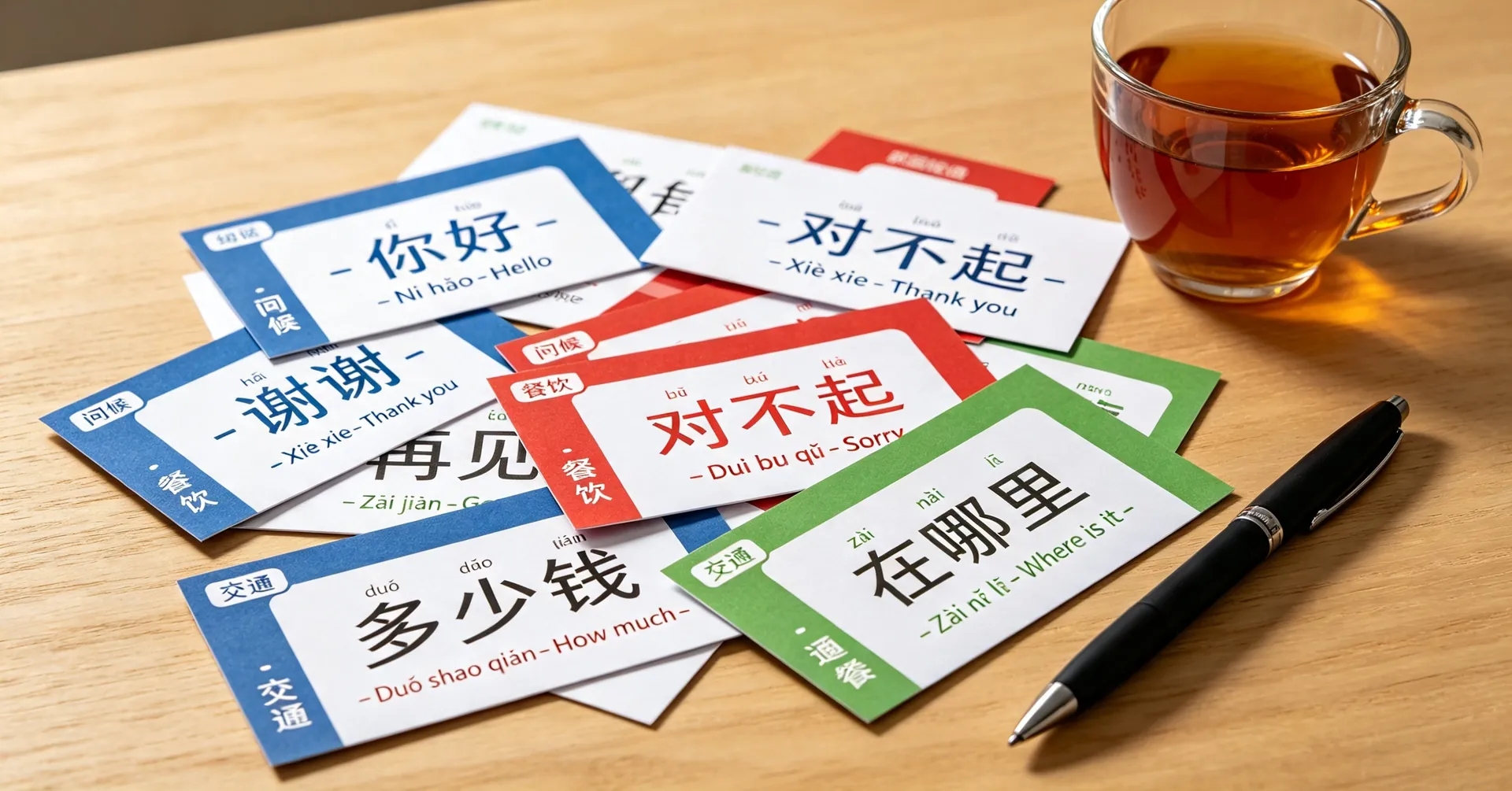
Sometimes the best tool is the simplest. These cards are designed to be screenshotted and saved to your phone, or printed before your trip. When you need to communicate, pull up the relevant card and show it.
Card 1: Taxi / DiDi Address Card
┌─────────────────────────────────────────┐
│ 请把我送到这个地址:                      │
│                                         │
│ [PASTE YOUR HOTEL ADDRESS IN CHINESE]    │
│                                         │
│ 我不说中文。谢谢!                        │
│ (I don't speak Chinese. Thank you!)      │
└─────────────────────────────────────────┘
Card 2: Food Allergy Card
┌─────────────────────────────────────────┐
│ 我有食物过敏!                            │
│                                         │
│ 我对 [花生 / 坚果 / 海鲜 / 牛奶 / 麦麸]    │
│ 过敏。请告诉我哪些菜不能吃。                │
│                                         │
│ (I am allergic to [...]. Please tell me   │
│ which dishes I cannot eat.)              │
└─────────────────────────────────────────┘
Card 3: Bathroom Locator
┌─────────────────────────────────────────┐
│ 请问洗手间在哪里?                        │
│                                         │
│ (Where is the bathroom, please?)         │
└─────────────────────────────────────────┘
Card 4: Hotel Return Card
┌─────────────────────────────────────────┐
│ 我不知道怎么回去,请送我到这个酒店:         │
│                                         │
│ [PASTE HOTEL NAME + ADDRESS IN CHINESE]  │
│                                         │
│ 如果我迷路了,请帮忙联系这个酒店。           │
│ 谢谢您的帮助!                            │
└─────────────────────────────────────────┘
English-Friendly Cities – Ranked
Not all Chinese cities are equal when it comes to English accessibility. Here's how they stack up for English-speaking travelers, from easiest to most challenging.
Tier 1: Most English-Friendly
| City | Rating | Why |
|---|---|---|
| Shanghai | ⭐⭐⭐⭐⭐ | China's most international city. English signage on every metro line and in most restaurants in the Former French Concession and Lujiazui. Hotel concierges are fluent. Young Shanghainese professionals often speak conversational English |
| Beijing | ⭐⭐⭐⭐☆ | As the capital and host of two Olympics, English is widespread at tourist sites, museums, and hotels. Metro lines have English announcements. Street-level English drops significantly once you leave the tourist core |
| Shenzhen | ⭐⭐⭐⭐☆ | A young, migrant-driven tech hub. Hotel and business-district English is good. The metro is fully bilingual. Outside the tech zones, expect limited English |

Tier 2: Moderate English
| City | Rating | Why |
|---|---|---|
| Guangzhou | ⭐⭐⭐☆☆ | Canton Fair legacy means hotel and trade-show English is solid. Street-level English in the old city (Liwan, Yuexiu) is minimal. Dim sum restaurants rarely have English menus — use photo translation |
| Hangzhou | ⭐⭐⭐☆☆ | English at West Lake tourist zone is adequate (signage, audio guides). Once you leave the lake area, expect almost no English. Tea village visits require a translation app |
| Chengdu | ⭐⭐⭐☆☆ | Panda Base has English signage. The rest of the city? Limited. Hot pot restaurants are menu-by-photo territory. The laid-back local culture means people are patient with gestures |
Tier 3: English Is Scarce
| City | Rating | Strategy |
|---|---|---|
| Xi'an | ⭐⭐☆☆☆ | Terracotta Warriors has English audio guides and signage. The Muslim Quarter is point-and-eat. Elsewhere, rely entirely on translation apps and address cards |
| Guilin · Yangshuo | ⭐⭐☆☆☆ | Yangshuo's West Street is surprisingly English-friendly (backpacker legacy). Guilin city center has limited English. Rural Longji terraces — absolutely none |
| Chongqing | ⭐⭐☆☆☆ | A massive local city. Minimal English outside luxury hotels. Hot pot ordering is an adventure — bring a translation app or embrace the unknown |
| Xiamen | ⭐⭐☆☆☆ | Gulangyu Island tourist zone has some English. Local seafood restaurants and markets — zero. The younger generation in coffee shops may speak basic English |
| Kunming · Qingdao · Harbin · Nanjing · Suzhou · Zhuhai | ⭐⭐☆☆☆ | These cities see fewer independent foreign travelers. Prepare with offline translation, address cards, and the DiDi app. Hotel concierges in international chains are your lifeline |
How to Get Around Without Chinese
DiDi – English Version Setup
DiDi (滴滴) is China's Uber — and it has an English interface. Setting it up before you need it is one of the smartest things you can do.
| Step | Action |
|---|---|
| 1. Download | App Store / Google Play → search "DiDi" (the icon is an orange car silhouette). Some regions require the "DiDi Rider – Greater China" version |
| 2. Switch Language | Open the app → tap Me (bottom right) → Settings (gear icon) → Language → select English. The app restarts in English |
| 3. Register | Enter your foreign mobile number (the one linked to your Chinese SIM card). DiDi sends an SMS code for verification |
| 4. Set Pickup | The app uses GPS to determine your location. You can also manually move the pin or type an address. The map is in Chinese — but your pickup location is GPS-accurate |
| 5. Enter Destination | Type the name of your destination (hotel name in English usually works). Better: have your hotel address in Chinese characters and paste it into the destination field |
| 6. Message Driver | DiDi has canned messages ("I'm at the main entrance", "I'm wearing a red jacket") that auto-translate between Chinese and English. Use them |

Metro Systems
Metro systems in major Chinese cities (Beijing, Shanghai, Guangzhou, Shenzhen, Chengdu, Hangzhou, Nanjing, Xi'an) all have:
- Bilingual station names (Chinese + Pinyin romanization) on maps and signs
- English announcements for upcoming stations on most lines
- Ticket machines with English language options
- Color-coded lines with clear transfer signage
The MetroMan app (free, available worldwide) provides fully English metro maps for every Chinese city, works offline, and calculates the best route between any two stations.

Hotel Concierge – Your Secret Weapon
The single most underutilized resource in China: your hotel front desk. Before heading out for the day:
| What to Ask For | Why |
|---|---|
| Hotel business card | Has the name, address, and phone number in Chinese. Hand it to any taxi driver to get back |
| Destination written in Chinese | Ask the concierge to write down your day's destinations in Chinese characters. Photograph them |
| Restaurant recommendation + reservation | The concierge can call ahead, make a reservation, and tell the restaurant you're coming |
| "Please help me explain..." | If you have a complex question for a shop or service, the concierge can write it in Chinese or make a phone call on your behalf |
Frequently Asked Questions
Can I travel in China only speaking English?
Yes, but it requires preparation. Install translation apps with offline Chinese packs before departure. Save key phrases as screenshots. Have your hotel address in Chinese characters. Use DiDi's English mode for taxis. In major cities like Shanghai, Beijing, and Shenzhen, English signage and metro announcements make independent travel feasible. In smaller cities and rural areas, the language barrier is significant — bring patience and a good translation app.
What is the best translation app to use in China?
Google Translate (camera mode) for menus and signs. Baidu Translate for voice conversations (better Chinese recognition). Pleco as a dictionary — the OCR mode lets you tap any character for an instant definition. Install all three, and download their offline Chinese language packs before departure. No single app does everything perfectly.
Do taxi drivers in China speak English?
Almost never. Use the DiDi app (set to English) instead of hailing street taxis — DiDi lets you input your destination in English, handles payment, and includes canned translated messages to communicate with the driver. If you must take a street taxi, have your destination written in Chinese characters and show it to the driver.
Are restaurant menus in China in English?
In tourist-heavy areas (the Bund in Shanghai, Nanluoguxiang in Beijing, West Street in Yangshuo), yes — many restaurants have English or photo menus. In local neighborhood restaurants, almost never. Use Google Translate's camera mode to scan text-only menus in real time. Pointing at photos on review apps like Dianping (大众点评) also works.
Which city in China is most English-friendly?
Shanghai is the most English-friendly city in China — bilingual metro signage, a large expatriate community, and a service industry accustomed to international visitors. Beijing and Shenzhen are close behind. See the full city ranking above for detailed ratings and strategies for each city.
Internal Links
City guides:
- Shanghai · Beijing · Shenzhen · Guangzhou · Hangzhou · Chengdu · Xi'an · Guilin · Chongqing · Xiamen · Kunming · Qingdao · Harbin · Nanjing · Suzhou · Zhuhai
Essential guides:
- China Tourist Visa Guide 2026
- Payment in China – Alipay, WeChat Pay & Cash Guide
- Internet in China – SIM Cards, VPN & WiFi Guide
- Essential China Travel Tips
You Don't Need to Speak Chinese. You Need to Be Prepared.
The travelers who struggle most with the language barrier are the ones who arrive assuming English will be widely spoken. The travelers who breeze through are the ones with translation apps pre-installed, offline packs downloaded, address cards screenshotted, and DiDi set to English mode. It's 30 minutes of preparation that turns "I can't communicate" into "I've got this."
What was your China language experience?
Did you find English in unexpected places? Was there a specific phrase or app that saved you? Share your tips and stories below — your experience helps the next traveler feel a little less intimidated about crossing the language barrier. And make sure to check our payment guide and internet guide for a fully prepared trip.
Next Steps for Your Trip
Now that you've got the language basics down, here are the other essentials:
- Payment Guide — Set up Alipay and WeChat Pay before you arrive
- Visa Guide — Check if you need a visa and how to apply
- Internet & SIM Guide — Get online the moment you land
- Beijing Travel Guide — Your first stop in China
- Shanghai Travel Guide — China's most international city
Ready to plan your route? See our Complete Route Planner.
Continue Reading
China at a Glance: Fast Facts, Geography, People & Travel Essentials
Everything you need to know before traveling to China — size, population, ethnic groups, language, time zones, currency, and more. Your complete China overview for 2026.
Essential China Travel Tips 2026: Internet, Payment, Transport & Safety
Everything you need to know before traveling to China — VPN setup, mobile payments, high-speed trains, safety tips, packing checklist, and more. A practical guide for first-time visitors.
Payment in China as a Foreigner – Alipay, WeChat Pay & Cash Guide
Master mobile payments in China. Step-by-step Alipay & WeChat Pay setup for foreigners with foreign cards, Visa/Mastercard usage, cash tips, and city-by-city payment friendliness.
Get Weekly China Travel Tips
Join our newsletter for destination guides, travel hacks, visa updates, and insider recommendations delivered to your inbox.
No spam. Unsubscribe anytime.