10 Best Chinese Street Foods You Must Try
China has one of the world's greatest street food cultures — a universe of sizzling skewers, steaming baskets, and crispy pancakes that changes completely from city to city. This guide covers the 10 street foods you absolutely cannot miss, where to find them, how much they cost, and how to order like a local.
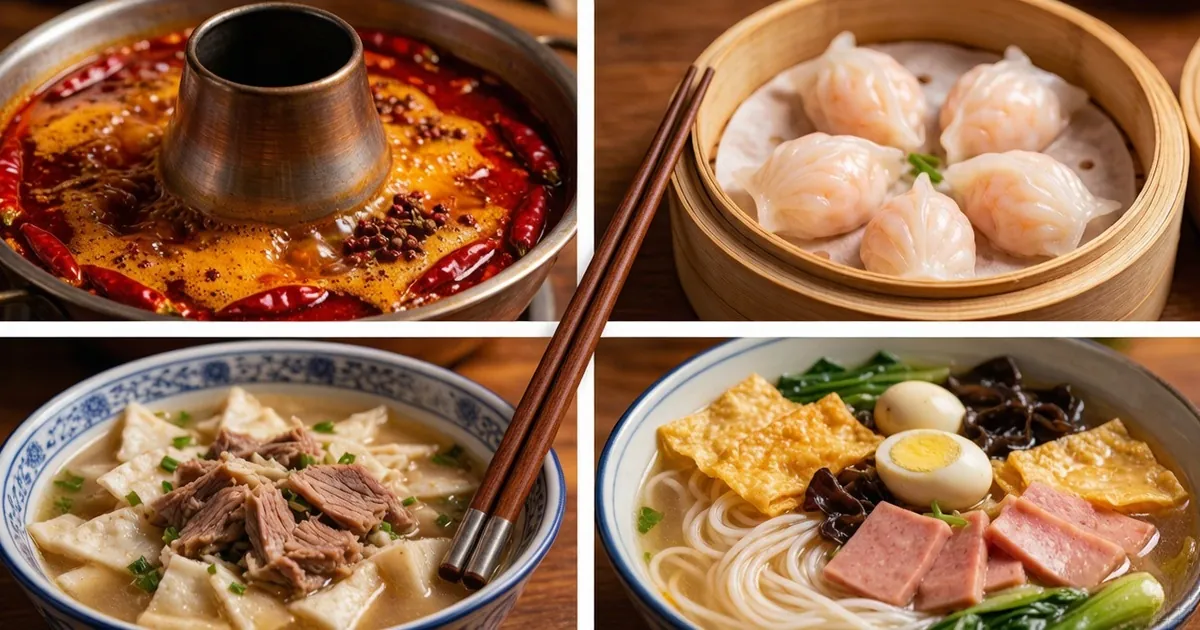
1. Jianbing (煎饼) — Beijing's Breakfast Legend
What it is: A thin crepe made from mung bean and wheat batter, spread onto a circular griddle, cracked with an egg, brushed with hoisin and chili sauce, sprinkled with scallions and cilantro, folded around a crispy wonton cracker, and handed to you in a paper bag.
Where to find it: Street corners across Beijing, before 10 AM. Look for the carts with the circular griddle.
Price: ¥6-10 ($0.80-1.40)
How to order: Just say "Lái yī gè jiānbing" (来一个煎饼). Add "jiā jīdàn" (加鸡蛋) for an extra egg.
Pro tip: The best jianbing stalls have a queue of office workers at 7 AM. No queue? Keep walking. The texture should be crisp on the outside, tender within — if it's soggy, the batter was wrong.
2. Xiaolongbao (小笼包) — Shanghai's Soup Dumplings
What it is: Delicate wheat dumplings filled with pork and a rich, gelatinous broth that turns to soup when steamed. The pleats at the top are the signature — 18 folds is the traditional count.
Where to find it: Shanghai — Din Tai Fung (chain, consistent quality), Nanxiang Bun Shop (Yu Garden, the original), or any local dumpling house.
Price: ¥30-60 for 8 dumplings ($4-8)
How to eat: The famous rule: "Lift gently, move slowly, open a window, drink the soup" (轻轻提,慢慢移,先开窗,后喝汤). Put the dumpling on your spoon, bite a small hole in the side, blow to cool the soup, sip it, then eat the rest dipped in Zhenjiang black vinegar with ginger shreds.
Pro tip: Don't pop the whole dumpling in your mouth at once — the soup inside is boiling hot. And the best vinegar for dipping is Zhenjiang black vinegar, not plain rice vinegar.
3. Chuan'r (串儿) — Xi'an's Lamb Skewers
What it is: Bite-sized pieces of lamb marinated in cumin, chili, and salt, grilled over charcoal on thin metal skewers. The defining smell of Xi'an's Muslim Quarter at night.
Where to find it: Xi'an Muslim Quarter — the narrower the alley, the better the skewers. Look for stalls with a mountain of raw skewers on a tray.
Price: ¥3-5 per skewer — order by the dozen ($0.40-0.70 each)
How to order: Say "mài shí gè" (买十个) for 10 skewers. Ask for "yī diǎnr là" (一点儿辣) if you want less spice.
Pro tip: The best cuts are yáng ròu jīn (羊肉筋) — lamb tendon with a strip of fat. Chewy, crispy-edged, and more flavorful than pure lean meat. Always order by the dozen — the skewers are small.
4. Stinky Tofu (臭豆腐) — China's Love-It-or-Hate-It Classic
What it is: Fermented tofu deep-fried until black and crispy on the outside, soft and custard-like on the inside. The fermentation process creates the infamous smell; the flavor is surprisingly mild and savory.
Where to find it: Night markets in every Chinese city — Changsha claims the best version, but it's excellent everywhere.
Price: ¥10-15 per serving ($1.40-2.10)
Pro tip: The smell is far stronger than the taste. If you can get past the initial aroma, you'll find a genuinely delicious snack. The Hunan version (Changsha-style) comes with chili and pickled cabbage. The Sichuan version adds Sichuan peppercorn. Try both.
5. Hot Dry Noodles (热干面) — Wuhan's Breakfast Obsession
What it is: Alkaline wheat noodles blanched and tossed with sesame paste, soy sauce, pickled vegetables, chili oil, and scallions. No broth — just a coating of nutty, savory sesame sauce.
Where to find it: Wuhan — Hubu Alley (户部巷) is the epicenter. Look for carts with a giant pot of boiling water and noodles being tossed in the air to cool.
Price: ¥5-8 ($0.70-1.10)
Pro tip: Eat it immediately — the noodles start clumping within 3 minutes. Stand at the counter, toss the noodles with chopsticks to evenly coat them in sesame sauce, and inhale. If you're adding chili, go easy — the sesame sauce is the star.
6. Shengjian Bao (生煎包) — Shanghai's Pan-Fried Buns
What it is: A yeast bun filled with pork and broth, pan-fried in a shallow layer of oil until the bottom is golden-crisp and the top is soft and fluffy. Sprinkled with sesame and scallions.
Where to find it: Shanghai — Yang's Dumplings (小杨生煎) is the most famous chain. The original shop on Huanghe Road has queues year-round.
Price: ¥8-12 for 4 buns ($1.10-1.70)
How to eat: Bite off the top (the soft part) first to release steam, sip the broth, then eat the rest — crispy bottom last. Dip in vinegar.
Pro tip: Don't bite into the crispy bottom first — you'll spray hot broth everywhere. The distinguishing feature of Shanghai-style shengjian is the thick, crisp bottom formed by the pan-frying process. Compare with Nanjing-style, which has a thinner, more delicate wrapper.
7. Chuan Chuan Xiang (串串香) — Chengdu's Hot Pot on a Stick
What it is: Hot pot's more casual cousin — skewers of meat, vegetables, and tofu are laid out on open shelves. You grab a basket, fill it with skewers, and the restaurant boils them in a bubbling pot of spicy Sichuan broth at your table. Payment is by the skewer at the end.
Where to find it: Chengdu — Ma Lu Bian Bian (马路边边) is the most famous chain. Any restaurant with open refrigerators of skewers and a fiery red broth is authentic.
Price: ¥0.60-2 per skewer — total ¥30-60 per person ($4-8)
How to order: Grab a basket and a plate, fill up on skewers from the open fridge. Give the basket to the kitchen, and a pot of boiling broth will arrive at your table. Don't be shy — the more variety, the better.
Pro tip: Essential ingredients: goose intestine (鸭肠, 15 seconds), beef tripe (毛肚, 10 seconds — don't overcook!), lotus root (藕片), and potato slices. The dipping sauce is a mix of sesame oil, garlic, cilantro, and a pinch of salt.
8. Egg Waffles (鸡蛋仔) — Hong Kong's Sweet Street Icon
What it is: A bubble-shaped waffle cooked in a special cast-iron mold — crispy on the outside, soft and airy inside. Available in original, chocolate, matcha, and taro flavors.
Where to find it: Hong Kong — Mong Kok's street stalls are the classic location. Try Mammy Pancake on Argyle Street.
Price: ¥15-25 ($2-3.50)
Pro tip: Eat them hot, fresh off the griddle — the crispiness lasts about 5 minutes. Tear off individual bubbles rather than biting into the whole sheet. The original egg flavor (原味) is the classic; red bean (红豆) and custard (奶黄) are excellent variations.
9. Roujiamo (肉夹馍) — China's Answer to the Hamburger
What it is: Braised pork belly (or lamb in Muslim areas) stewed for hours with star anise, cinnamon, and soy sauce, then chopped and stuffed into a freshly baked wheat flatbread. The bread is crisp on the outside, soft and steamy inside.
Where to find it: Xi'an is the birthplace — the Muslim Quarter has dozens of stalls. Beijing and Shanghai also have excellent versions at Shaanxi restaurants.
Price: ¥8-15 ($1.10-2.10)
Pro tip: Ask for "féi shòu dā" (肥瘦搭) — a mix of fatty and lean meat. The fat adds juiciness and flavor. The bread should be freshly baked in a clay oven — if it's reheated in a microwave, walk away.
10. Baozi (包子) — The Universal Chinese Street Breakfast
What it is: Steamed buns filled with pork, vegetables, or sweet red bean paste. The fluffy white bread contrasts with the savory or sweet filling inside. The king of portable Chinese breakfasts.
Where to find it: Any city, any street corner, any morning — look for the tall bamboo steamers outside shopfronts.
Price: ¥2-5 each ($0.30-0.70)
Varieties to try:
- Zhūròu bāozi (猪肉包子) — pork and green onion, the classic
- Sānxiān bāozi (三鲜包子) — "three delicacies" (pork, shrimp, egg)
- Shūcài bāozi (蔬菜包子) — vegetable, good for vegetarians
- Dòushā bāo (豆沙包) — sweet red bean paste, for dessert
Pro tip: The best baozi shops sell out by 9 AM. Look for places where locals are carrying away bags of 10-20 buns. The wrapper should be bouncy — press it gently; it should spring back.
Food Safety Tips
| Concern | Reality | Advice |
|---|---|---|
| Street food safety | China has strict food safety laws; most stalls operate with permits | Choose stalls with high turnover (ingredients are fresh) |
| Spice level | Sichuan and Hunan food can be extremely spicy | Order "wēi là" (微辣 / mild spice) or "bú là" (不辣 / no spice) |
| Allergies | Peanut oil is rarely used; soy is in everything | Learn your allergen in Chinese and show it on your phone |
| Tap water | Not drinkable anywhere | Drink bottled water or boiled water |
| Ice | Reputable restaurants use purified ice | Skip ice at street stalls; order drinks warm or room temperature |
Where to Find the Best Street Food by City
| City | Best Street Food Area | Signature Dish |
|---|---|---|
| Beijing | Wangfujing Night Market, hutongs near Gulou | Jianbing, lamb skewers, zhajiang noodles |
| Shanghai | Yunnan Road Food Street, Fuxing Road | Xiaolongbao, shengjian bao, scallion oil noodles |
| Xi'an | Muslim Quarter (回民街) | Lamb skewers, roujiamo, biang biang noodles |
| Chengdu | Kuanzhai Alley, Jinli Street | Chuan chuan xiang, dan dan noodles, mapo tofu |
| Chongqing | Jiefangbei area, night markets | Chongqing hot pot, xiao mian noodles |
| Wuhan | Hubu Alley (户部巷) | Hot dry noodles, doupi, duck neck |
| Guangzhou | Shangxiajiu, Beijing Road | Dim sum, clay pot rice, roast goose |
| Hong Kong | Temple Street, Mong Kok | Egg waffles, curry fish balls, pineapple buns |
🔗 Related
- China Food Culture Guide →
- Chengdu Food Guide →
- Xi'an Food Guide →
- Shanghai vs Beijing Food →
- Payment Guide for Travelers →
Which Chinese street food are you most excited to try?
Tell us below — or share your own street food discovery from your trip!
Continue Reading
China in July 2026 – Where to Go, Weather & Travel Tips
Visiting China in July? Discover the best cities for summer travel, weather by region, festivals, crowd levels, and essential tips for surviving the July heat.
2026-07-01
China in August 2026 – Festivals, Mountain Escapes & Summer Survival
August in China means peak summer heat but also the Qingdao Beer Festival, Inner Mongolia's greenest grasslands, and Yunnan's perpetual spring. Find your perfect August destination.
2026-08-01
China in September 2026 – Best Month for Travel & Mid-Autumn Festival
September is China's golden travel month — clear skies, comfortable temperatures, the Mid-Autumn Festival, and the start of hairy crab season. Find the best places to visit in September.
2026-09-01
Get More China Travel Tips
Enjoyed this article? Join our newsletter for more practical tips, destination guides, and travel inspiration.
No spam. Unsubscribe anytime.